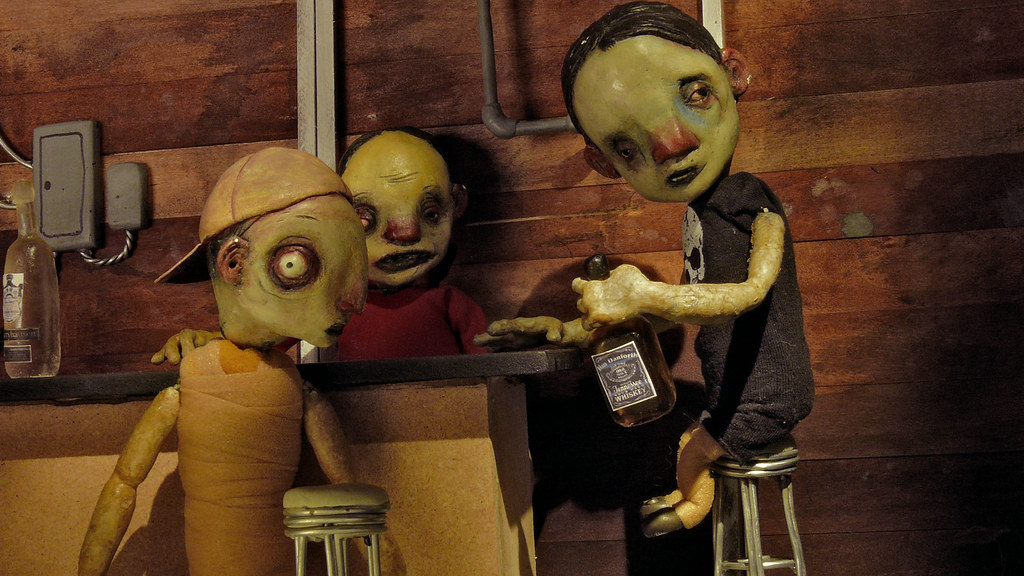
**I've modified this post slightly - added two sections of new text. Scroll down till you see sections in
yellow - that's the new stuff.**
Ok, enough pretty pictures - it's time for another dose of Cinemastudies! To set the stage for this post - bear in mind my sig at SMA is "Rules were made - not to be broken, but to be
OUTGROWN" (
Transcended might be even a better term). Also bear in mind I came into the stopmo world fired up by the Brothers Quay... in particular their masterpiece Street of Crocodiles - and my Ahab film is/has been/was/will be a surreal/expressionist statement. But very quickly after joining the message board I began to see that indeed I was not the first to think he could be the
Third Quay! Far from it! And the work of many of them leaves... shall we say a lot to be desired? So I came to the conclusion that surreal stopmotion in the vein of the Quays and Svankmajer is often little more than
dark, arty vagueness masquerading as substance - that even if you want to create a dreamlike surreal atmosphere you must give the audience something to fascinate them and hold their attention... you must not bore them or hurl crap at them! And I set out to try to learn what I could about making movies.
The first stop was in Storyland - studying straightfoward narrative filmmaking techniques (the Hollywood approach). Not because I had decided to forego surrealism or expressionism, but because I really do believe that in order to transcend the "rules" you should learn them first. And also because I realize there's still a good deal of straightforward narrative storytelling in most surrealist films! A fact those dark arty slacker types would never admit... far be it from them to actually have to learn how to tell a story - that's ordinary
bourgeois meat-and-potatoes stuff... not the realm of a true
ARTISTE! Well, I've now read quite a few books about screenwriting and storytelling, and I feel I've got at least a decent handle on it. Of course not as good as if I had made a dozen good narrative films.... but I'm hoping I can actually get through this in somewhat less than a lifetime!
So now I begin my next phase. A study of non-traditional approaches to filmmaking and storytelling. There's far less material available in this department.... just check Amazon for books about "screenwriting" and you'll find hundreds, if not thousands! But try to find any good books dealing with how to approach non-traditional filmmaking.... a few, but sparse pickins! I started by buying Film as a Subversive Art by Amos Vogel, and it feels like exactly what I was looking for - a good overview of all the various movements of Modern Cinema. From the bibliography of that book I also ordered a few more that are starting to trickle in now.... Antonin Artaud, Susan Sontag, Bertold Brecht.... could be pretty hit-and-miss reading, but could also get some good ideas stuffed into my head. Today's installment deals specifically with
poetic film and the World of Objects - but that doesn't mean it's my sole focus as a filmmaker. It's just the first of several studies I'll be doing, and after trying to wrap my head as well as possible around these different movements and approaches, then I feel I'll be more well equipped to figure out how to make a good satisfying movie that's something other than narrative. Ok, sorry I rambled for so long just in my intro.... with no further skidoo, here's what I've been thinking/writing about lately:
****An Investigation into Poetic Film - The World of Objects/Nature/AnimalsI call this an investigation because it's far from a complete statement. I don't claim to have "the answers" - I'm more interested in my own personal exploration. And I may well ignore entire aspects of poetic filmmaking because either I haven't noticed them yet or I'm not particularly interested in them. In later updates I may change my thoughts on some issues. In this installment I've concentrated specifically on The world of Objects/Nature/Animals and its use in poetic cinema.
Most Hollywood narrative films take place in the social sphere. And of course, all the "poetic" films also include narrative, but it's pushed into a secondary prominence, eclipsed by the interest in the beauty of the film's world. In a film like Secret Garden for instance, there's a story that does take place in the social sphere, concerning the other people in the movie, who are trying to bring the boy into that sphere, but he exists almost entirely outside it - in the world of objects - and their story is pushed into secondary prominence. He's recovering from a traumatic accident in which his mother died and he was trapped under her body as it grew cold, stuck there for hours before being rescued. I'm not sure if he was essentially catatonic at first? Or just extremely withdrawn. But now he collects objects that are striking for their surface, their texture or form.... pieces of fur that he rubs against his face and neck or runs his hands across sensuously, pieces of bark with a rough surface - he wears a ratty (but beautifully textured) old sweater all the time, even though it's fraying almost to pieces - and he keeps a pet rabbit that he likes to stroke continually. He doesn't respond to people most of the time, just sits daydreaming until he can get free to go to his treehouse where he hoards these treasures (In fact there seems to be an element of daydreaming, or of dreaming, in most poetic films). He seems to have slipped almost entirely into that world favored by Svankmajer - the world of objects. Though Svankmajer's goal is to demonstrate the hidden life of objects, he does exaggerate their qualities of form, texture and surface and his characters revel in rubbing various textures against sensitive parts of their bodies. In both cases, it's a fond remembrance of childhood, when we take in the world little by little through such tactics.
Children (as well as recovering trauma or disease patients or the mentally ill) also look at things in unusual ways... both physically and in terms of how they 'see' (comprehend) them. Children spend a lot of time laying on floors or on the ground. A room can look extremely different from that perspective! The underside of a table is a view denied most adults (except when assembling or repairing it) - a card table turned into a Sheik's tent with the aid of a blanket draped over it becomes a child's refuge, and he becomes intimately familiar with the unpainted, rough-surfaced underside of it, the gobs of glue left there by factory workers because nobody will ever see them - pencil marks used when cutting the wood - wads of chewing gum stuck there by guests. These are views adults tend not to see... they generally move through their world in the prescribed way and think of rooms or spaces according to their utilitarian purposes. Children see these same spaces as texture, surface, form, and the play of light and sound.
Another effect of sitting on the ground or the floor is that children see objects in extreme closeup. Grasshoppers, caterpillars, spiderwebs, unusual pebbles or bits of discarded machinery are examined in minute detail to the exclusion of the rest of the world. When you're close enough to the ground that the smell of it fills your nostrils and you can see tiny marching ants carrying their tiny burdens, it's like you're in another world entirely. Well do I remember long trips as a child in the back seat of the car, fighting off encroaching sleepiness against the hypnotic motion and sound of the car gliding along the highway.... peering out at twilight landscapes as they drift past in a play of dark forms dotted with lights against deep grey-blue skies and moody cloud formations. The regular sweep of streetlights overhead, their light striking in against the top edge of the seat and sliding slowly at first down - then forward, gaining speed, and suddenly whipping past to disappear as the next blade of light takes it's place. I also remember the taste of pencils, the crunch as teeth sink into them.
So one function of poetic films is to take a childlike look at the world... to escape the social realm into the realm of objects or nature or animals (they're very similar.... well in some sense they're all one wolrd, but with some differences). The social realm can get very tiresome, and one way to escape it is to drop out into this underlying world, which is always there, but we often ignore it. Even in narrative (social) films, there are often shots featuring a poetic look at surfaces or textures or a passage featuring beautiful composition or color. And in poetic films there is generally some narrative content... it's pretty hard to make a movie with none unless it's a fully abstract film intended for contemplation like the time-lapse film Baraka. But we distinguish a poetic film by it's greater insistence on this world, the pushing back of narrative and plot (and of the social realm) to focus more on the abstract or formal qualities. Focusing on these aspects tends to impart a tranquil, contemplative or meditative quality to such films. I mentioned trauma victims and recovering patients slipping into the world of objects.... it's also a safe haven for those thunderstruck by the sense of angst inspired by the modern sense of the world.... the loss of a comfortable anthropocentric world and universe, the destabilization of the Newtonian system of coordinates used to measure space for Einstein's rather forbidding Relativity and related Modern concepts of time and quantum physics that have all contributed to a sense of unease and tension (for instance the prevailing idea in Modern times that nuclear annihilation could be only a heartbeat away at any time). Plus the social realm - theater of upward mobility or sudden downward spirals - is rife with anxieties and pressures of its own and occasionally requires escaping. The world of objects always waits just beneath this artificial realm, a more real and implacable reality of sheer physical immediacy, and any sudden shock can send us there instantly. It's a world where there's no trickery - everything is exactly what it is and doesn't pretend to be otherwise. It's a world of brute force and the unbearable weight of stone - the pungent smell of wet earth and the slashing pain of barbed wire fences. But it's also a world of dappled light dancing beneath wind-stirred branches in the warm sun, and of the smell of honeysuckle and the music of birds and droning insects and trickling sweet brooks running over beds of smooth-worn pebbles.
Another big part of the beauty of this world - it's attractive power - is that it dissolves identity. When you're able to forget the social world and lose yourself in this microlandscape of insects and grains of sand and blades of grass studded with dewdrops it's a melting of personal boundaries. You can forget who you are.... forget even that you exist as a human being... just drift in this world of sight and sound. THAT'S why these films are so relaxing and soothing, even if there's a lot of tension in the film.One particular branch of poetic film looks toward the sky. Wim Wenders is a practitioner of this approach. I'm not sure if this can technically be called part of the world of objects, but is definitely the world of nature.... and it seems to appeal to the spiritual. Wide vistas of sky or vast cloud formations bring a sense of lightness or airiness that seem to lift the viewer from the heaviness of the ground, separate him from his earth-bound condition. A similar feeling results from shots of wide waving fields with the shadows of cloudbanks drifting across them... oceans of grass scrubbed by the wind. In fact any shot featuring the effects of wind - that invisible but powerful agent - can bring a sense of vastness and connectedness with parts of the world not included in the composition. The feeling can be light and airy, as in a soft breeze stirring the bobbing heads of flowers or gently lifting a group of flags to lazy half-life, or brisk and bracing - even to terrifying in its extremity - as in hurricane or tornado force wind. Kurosawa effects similar moods with shots of buildings or natural formations drenched in hard pounding rain. To see a familiar building under such intense conditions of weather makes it alien and plunges it into that waiting world of objects. Intense weather conditions can have the same alienating effect on people as well... exposed to hard rain individuals tend to withdraw and huddle into themselves - can become objects rather than social beings.
Some films seem to be set entirely in the world of objects or animals. There's a wonderful DVD (available through Netflix) featuring the short films The Red Balloon and White Mane.... two excellent examples of this type. In The Red balloon, I noticed after a while that the camera actually follows the balloon continuously - the boy who befriends it comes and goes, disappearing for spells into buildings where it can't follow so it waits outside for him. People's voices are heard occasionally, but only peripherally, as a door opens and someone speaks to the boy - but they move inside and the door closes, shutting out the rest of the conversation. In White Mane the camera actually shifts between the world of horses and the world of people - moving fluidly between the intertwined stories of White Mane, leader of a pack of wild horses living on the wide marshes of France, and the young boy who yearns to ride him. There is also a small cadre of Herdsmen who want to break White Mane and corral him, but they show up only as supporting cast through the eyes of the real main characters. One way it draws attention to the natural world in spectacular fashion is by its setting... I always thought of marshland as sloppy, muddy nasty stuff but now I see the sheet of water that stretches across the entire visible landscape (ranging from inches to about a foot and a half deep) seems to be clear, not stagnant and muddy as I had always assumed. Having never seen land submerged in clear water like this before I was riveted and fascinated by it. A similar strategy is used by Frantisek Vlacil in White Dove, where a beach consists of a long stretch of sand submerged in only about an inch of water. Very strange to see people walking and driving apparently on water! Very dreamlike.
This is where I've left off... consider it a pause. I'll add to it in the future, but it will never reach full stop.