Showing posts with label Gene Wolfe. Show all posts

Tuesday, July 16, 2013

CronenBergman... Or why movie spectacle and good old fashioned storytelling just don't mix (Newly edited)


What I've come to realize is that usually the movies that are spectacular don't have good stories, and I think it's because all the surface glitz, all the fast motion and staccato cuts and excessive spectacle is visual candy, meant to be addictive and leave you wanting more - and once you get sugar you don't want green beans and steak anymore. When you get the sugar rush going that's all you want anymore, until you get sick and puke it all up, and you're left feeling empty (a very apt description of my experience seeing quite a few modern blockbusters!) So it seems on a basic level the excessive spectacle and the meat and potatoes of storytelling are incompatible. 

Though there was a time in the late 70's and early 80's when some of the New Hollywood filmmakers like Spielberg, Lucas and Ridley Scott were still doing good solid storytelling and just starting to develop the modern excesses of spectacle that are pretty much all today's blockbusters consist of - but they were using it sparingly, only to spice up the story - the effects were still in support of the story rather than the other way around. The last director I'm aware of who worked like this in the sci-fi effects genre was James Cameron - not the Cameron of today, but when he did his early films - up through around T2, when he was starting to give in to the call of spectacle and CGI. I still feel like T2 is effects in support of story, though the dynamics were starting to shift already.

From what I understand, Spielberg wanted to do Jaws very differently - he wanted to be able to see the shark all the time, for the camera to be able to follow it underwater while it did loops and crazy stunts, but the mechanical shark didn't look good enough to allow that, so it was only by a twist of fate that we ended up with an actually great movie rather than the spectacular effects extravaganza he wanted to make. Instead he had to fall back on traditional tricks like not showing the monster too much, letting the viewers use their imaginations to fill in the blanks. Apparently he thought that was sub-par, when in actuality it made it a much better and more sophisticated film. I was really shocked and let down to discover that the greatness of that film was something that happened by accident… I had more faith than that in Stevie boy! Sad to see it was completely misplaced.

I've been on a huge Cronenberg kick lately (of all things!) - I just read 2 books, one about his films and one composed of his own words from interviews etc, and decided to watch all of his movies, all as part of my studies of directors and how they work. I was pretty surprised to hear him say that he admires Bergman and  Kurosawa and Godard and the other international directors of the postwar period and that he deliberately makes his movies like they did. Say WHAAAAT??!! At first I couldn't even comprehend what I just read - oh sure, Scanners, Videodrome and The Fly are just like The Virgin Spring or Seven Samurai!! Sure they are!

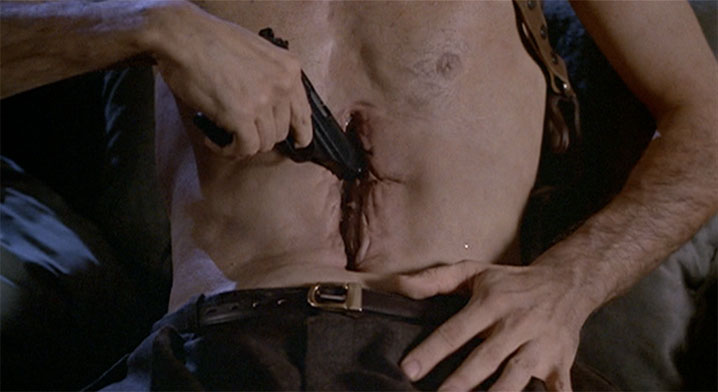
But after reading some more and watching his films starting from his first ones, I realized they actually are alike in many ways - there's no empty spectacle just to make it fast-paced for a modern popcorn crowd, but at the same time he doesn't (usually) do boring Drama movies about relationships or people trying to improve their social standing. I mean, he works in color, but so did Bergman and Kurosawa et al once that became cheap enough. And he does the crazy morphing body horror stuff - but that's the extent of anything spectacular in his work, and it's actually never just for shock effect or cheap horror scares the way Carpenter would use it - it's always to say something that the whole film is about - something philosophical about human nature. It's shocking, sure, but once you get past that (most people never do) and pay attention to what he's really doing, his films are actually built on very interesting philosophical ideas, not just on scares or gross-outs. All of Cronenberg's films turn out to be doing the same thing in different ways - physically externalizing an internal state --- manifesting psychological conditions literally in the flesh - done through body horror special effects in most of his early films, and through performance technique in everything from Dead Ringers on (everything after The Fly if I remember right, which isn't my strong point).

He did a film called Crash, which involved nothing but sex and car crashes, and still he didn't give in to the temptation to go all Hollywood Blockbuster style - the crashes are simple and quick, no explosions, no slow motion shot from 12 different angles, no elaborate setups or ticking countdowns or anything. No tough-guy muscle-head drivers spouting off cheesy one-liners. None of it is for exploitation, it's all to explore the ideas his movies are based on. His actors can really ACT - they're not models who decided to try their hand at being in Sy-Fy Channel style crapfests.

Actually the same is true of David Lynch and Kubrick too  -both of whom Hollywood doesn't know what to do with because their work is about ideas and even though it flirts with the same material Hollywood uses only for cheap thrills it's used thoughtfully and intelligently - something severely lacking in Hollywood since sometime in the mid 80's at least.

And something I realized about all of them - even though they do use great cinematography and are known for it, it's never ostentatious and it always always serves the story rather than the other way around. In fact most of their cinematography is quite simple and straightforward - the reason it tends to look so nice is because they're shooting things that are inherently interesting and they carefully arrange visual elements for greatest storytelling clarity (not visual eye candy effect) and they or their cameramen (both in most cases) have a great eye for composition.

It might seem odd that I mentioned David Lynch in this article. He's different from the rest because his stories are usually pretty surreal and don't follow standard narrative convention. And like Cronenberg, his work shocks people raised on the standard Hollywood formulas and happy endings. But in spite of the sometimes frightening or nightmarish nature of some parts of his films, he's known as the Jimmy Stewart of surrealism. He looks a lot like Mr. Stewart, and in fact he describes his childhood as very Norman Rockwell. It was idyllic and serene, but he was always fascinated by the little red ants that swarmed unseen on the beautiful trees, and the weird patches of dripping slime. So most of his films focus on that dichotomy - a pastoral idyllic world that when examined closer reveals a nightmarish underworld hidden just beneath the surface, which erupts through from time to time. He also likes to examine themes of duality, many of his female characters split into 2 people (I think only one of his male characters does the same, in Lost Highway). This duality of human nature is actually one of the great themes running through the annals of human thought from the heady days of the Greek philosophers onward, with significant stops at Freud and Jung and throughout the great world literature. All of these directors concern themselves with thematic material that is pretty well known to readers of great literature or philosophy or psychology - it's just considered too difficult or challenging for Joe Six Pack and Suzie Homemaker, who would rather be watching American Idol or Real Housewives.

** EDIT:
I just made the connection between Lynch's idyllic pastoral neighborhoods erupting with insect plagues and slime with what happens to his human characters. It's pretty obvious once you've made the connection, but it's the same thing applied to landscape rather than person. In Lost Highway for instance the man and his wife both start off as happy, successful well-adjusted yuppie types until suddenly a mysterious video tape shows up one night that begins a series of transformations essentially ripping away that outer illusion to reveal the seething murderous shadow personae of them both lurking inside unsuspected. The same happens to Betty Elms/Diane Selwyn in Mulholland Drive - through most of the movie we see her shiny happy Hollywood Hopeful dream self, smiling brightly and all innocent, finding instant success and friendship on arriving, but little by little her Shadow self bursts through, which had always been there but unseen, unsuspected. It's the parts of ourselves we hide away because we don't want to own them, and when they do show their ugly faces we don't recognize them as ourselves. That's why he actually changes their names and has them played by different actors sometimes. 

Ironic now that I posted the 2 names of the Naomi Watts character - her shiny happy character is even named for trees! 

It's also the kind of thematic material I've discussed a few other times on this blog - most prominently in my articles about Gene Wolfe, a writer often relegated to the science fiction and fantasy shelves, but who says the type of work he does actually concerns itself with the biggest human issues - things that can't be touched by the very limited scope of the social realist novel, a genre that only arrived on the scene relatively recently and that according to him won't last very long. The great work of the world's most ambitious thinkers - Homer, Shakespeare, Goethe etc, does not limit itself to the workaday lives and ambitions of ordinary folk. It's true that in their most limiting genre forms science fiction and fantasy are extremely weak, but if a writer or filmmaker really wants to broaden his scope to include the full range of human experience and thought, then he needs to reach out to the outer limits, beyond the pale of everyday experience - and then you find yourself in uncategorizable territory, dealing with stuff that gets you classified as science fiction and/or fantasy, though really it may be closer in nature to myth.  And that's one thing all the filmmakers I listed above definitely have in common. Well, many of them at least used-to concern themselves with this level of experience, but have since switched over to glitzy shiny empty spectacle, which brings in much better opening weekend box office. What is it this is called? Oh yeah, that's right - selling out! 

Friday, September 12, 2008

Further clarification of Poetic Fiction/Narrative

Photobucket


Ok guys, I know most of my readers would rather see exciting progress pics than read more of my blatherings about poetic fiction, but this is what's happening right now in the Realm of Darkstrider. I get on these obsessive kicks, and for a while my mind cogitates and broods over these concepts, slowly simmering the stew until it's done. And right now, this is what's cooking. I need to get it down before it slips away forever, and I'll share it with anyone who stops by. Hold out your bowl and wooden spoon, and I'll ladle some out.

I've been reading more Gene Wolf. Got 2 books - The Doctor of Death Island and 5th Head of Cerberus. Cerberus is by far the better book IMHO, consisting of 3 novellas that interlink together to tell a single sprawling story, each part being written by a different character. Island is a collection of short stories, of which I only really liked a couple. The ones I like are the ones that deal with his obsessive themes - the nature of humanity (explored through variations of cloning, mutation, artificial beings, robots, and various other false humans) - the elusiveness and kaleidoscopic nature of memory and its often surprising clarity, family drama in the vein of Shakespeare or Homer, and the difficulties and occasional joys of communication between people. I probably missed a few too.

These are the same themes explored by the Absurdist playwrights and by other great writers of the modern era. He also uses a sophisticated and unusual technique for telling his tales that reminds me of a particular strain of modern films... particularly the New Waves (French, German, Italian Neo Realism etc) and their American progeny like The French Connection, The Graduate etc. There's a certain terseness, cutting directly to the important parts and not over-explaining and smoothing things over for the slow students the way Hollywood films tend to do. In the films I mentioned, there are abrupt, almost shocking cuts from a slow silent scene to a noisy, fast moving one. Elision I believe is the word.... compressing elements together and extracting what's unnecessary. Trusting the viewer to be able to fill in the blanks, or better yet to follow the real storyline without needing extraneous details that they've become used to from so many lackluster films made to appeal to the lowest common denominator. Personally I enjoy films that are just a bit challenging like this, though hopefully they actually do seem to make sense if you delve into them and don't just end up a hopelessly confused mess. Sometimes Wolfe's writing leaves me behind, but I always get the definite feeling that further work on my part would bring me up to speed. And that's something I also want to discuss here....

Reading more of Wolfe's stories helps to explain things you might have missed. Many of his short stories deal with issues that he later compiled (in different form) into the masterwork Long Sun series. 5th Head of Cerberus in particular, and the story Hero as Werwolf from Doctor of Death Island. The character from the central novella in 5th Head bears a close resemblance to Severian in fact. And the more of his stories I read, the more the mysteries begin to clear up. But not entirely yet, thank god! That mystery is a big part of the appeal of his work.

His fiction is what I call Poetic Narrative. I've spliced the two (normally exclusive) terms together to describe a type of story I'm drawn to. If you look at the block of white text just to the right, where my About Me section is supposed to be, it's Martin Esslin's extremely enlightening description of the way Theater of the Absurd works. Very different from the much more familiar narrative structure we see in 99% of Hollywood movies. Rather than arranging things in an easily comprehensible timeline and following a clear storyline, it presents pieces of the "poetic image", in no particular order, and it's the job of the viewer to put the puzzle together and try to figure it out. But there are stories that do something midway between the two, which I'm referring to as Poetic Narrative. These would include films like Mulholland Drive (and just about anything by Lynch), Paris Texas, and Marketa Lazarova. I could name more, but these are the examples that spring to mind (and the ones I keep using, I know). They use the elision as was done in the New Wave films, but unlike the more hardline Absurdist plays, there's still a narrative to follow. From what I know of Absurdist plays, the idea is to completely mix up the order and the logical flow of ideas, scramble them like puzzle pieces in the box that the viewer must then piece together in order to create the "poetic image". Only then does it make sense.

This kind of gamesmanship is obviously only for the hardcore viewers, who love to be challenged and don't care to be entertained. I don't class myself in that camp, and I want to make appealing films that at least 40% of the normal viewing audience would actually enjoy even if they don't fully "get it". I enjoy Wolfe's books, even though I know there are levels that fly right over my head. The way he writes them, you don't need to fully solve the puzzles to reap enjoyment, though that level is there if it's something you feel compelled to do.

I don't know if I've really said anything new here, I thought I had more. But at least I've clarified some of the ideas that have been whirling through my cranial cavity (and hey, I don't just write these things for you guys you know.... I might need to look in here later to remind myself of something!) I was also going to include my newly improved analysis of the differences between Street of Crocodiles and Madame Tutli-Putli, which has yielded much better results since my studies into Theatre of the Absurd, but that feels like a completely different topic that deserves it's own post, so I'll do it separately and make 2 posts right after each other (well, it might make up for so much down time on my blog lately... a bit of a bonus to my readers for their patience). See ya then! (though you probably read that post before this one, if you didn't completely miss this one thanks to my inconsistent posting habits! ... And if you did, then who am I talking to anyway??!!)

Monday, August 11, 2008

Incredible Gene Wolfe interview

Photobucket


Tonight I was trolling around the web, trying to find authors similar to Gene Wolf (huh... RIGHT! As IF!!!) when I suddenly and quite surreptitiously ran across this lengthy and absolutely astonishing interview with the man himself. (The link is also posted at the end of this - um - post!) Let me put this into perspective (if that's possible)....

It's been probably a little over a year since I discovered Wolfe and read the massive Book of the New Sun. I count it as THE highlight of my reading career, and I'm still stunned and amazed by the sheer inventiveness and audacity of that series. The intelligence, the subtle and perceptive grasp of human nature and of the nature of reality and the universe.... in other words, things you seldom find in genre writing (which Wolfe's work most definitively ISN'T, though with their penchant for labeling, bookstores are forced to put him in with the sci-fi and fantasy authors - he fits in with them about as well as Shakespeare fits in with soap opera writers).

And now I feel like I've already found the very best.... there's basically no chance of ever topping his work. Since then I've been WANTING to find authors that exist at that dizzying pinnacle... TRYING to, and despairing of it ever actually happening. I've made a few really excellent finds in the attempt, such as Paulo Bacigalupi, Ted Chaing (who's book Stories About Your Life and Others I just picked up and am enjoying immensely), and David R Palmer, who's story Tracking was serialized in three recent issues of Analog magazine and soon to be printed as a novel, along with the long out-of-print Emergence, to which it's a sequel. But really they don't stand up to the comparison. The only authors I've read extensively who do would be J G Ballard and Angela Carter for their immense ability to create self-contained worlds of pure bravura imaginativeness (if that's even a word).

Incidentally, it occurred to me after making that recent post about what I'm reading that this imaginativeness, this ability to CREATE a thematically-unified world that isn't just a copy of drab reality is the unifying thread that binds together all my favorite authors, including even my earliest such as Andre Norton and Keith Laumer, who I mentioned in that post as writers of (somewhat) standard narrative fictions (as compared to the more poetic writers that post was mainly concerned with).

Wow, sorry, I don't mean to run to such loquaciousness.... let me try to cut to the chase.

In this long interview, Wolfe explains that his fiction is essentially the OPPOSITE of genre science fiction.... that rather than create little worlds where characters can act out simplistic ideas, he weaves a dense tapestry filled with intertwining concepts that cover pretty much the gamut of human thought... with an especial consideration for the more profound, such as language and how it shapes thinking and character, memory (and in particular memories of memories... ) why monsters are really US, and the unreliability (relativity) of narrators for various reasons. He says there's no separating form from subject... they interpenetrate and create each other in a symbiotic relationship.

... And as I was reading, it suddenly occurred to me that his ideas are very similar to those of the Absurdists, who's theories I recently wrote about. But I Must say, I vastly prefer reading his books to watching the plays of Samuel Beckett or the rest of the gang.

Following are a couple of excerpts from the interview to whet the appetite:

Larry McCaffery: Could you discuss what sorts of things have drawn you towards writing SF? Do you find there are certain formal advantages in writing outside the realm of "mainstream" fiction, maybe a freedom that allows you more room for exploring the issues you wish to develop?


Gene Wolfe: It's not so much a matter of "advantages" as SF appealing to my natural cast of mind, to my literary imagination. The only way I know to write is to write the kind of thing I would like to read myself, and when I do that it usually winds up being classified as SF or "science fantasy," which is what I call most of my work. Incidentally, I'd argue that SF represents literature's real mainstream. What we now normally consider the mainstream—so called realistic fiction—is a small literary genre, fairly recent in origin, which is likely to be relatively short lived. When I look back at the foundations of literature, I see literary figures who, if they were alive today, would probably be members of the Science Fiction Writers of America. Homer? He would certain belong to the SFWA. So would Dante, Milton, and Shakespeare. That tradition is literature's mainstream, and it has been what has grown out of that tradition which has been labeled SF or whatever label you want to use.


LM: That's why I began by asking if you weren't attracted to the freedom offered by SF—it's only been since the rise of the novel in the 18th century that writers have more or less tried to limit themselves to describing the ordinary world around them....


Wolfe: It's a matter of whether you're content to focus on everyday events or whether you want to try to encompass the entire universe. If you go back to the literature written in ancient Greece or Rome, or during the Middle Ages and much of the Renaissance, you'll see writers trying to write not just about everything that exists but about everything that could exist. Now as soon as you open yourself to that possibility, you are going to find yourself talking about things like intelligent robots and monsters with Gorgon heads, because it's becoming increasingly obvious that such things could indeed exist. But what fascinates me is that the ancient Greeks already realized these possibilities some 500 years before Christ, when they didn't have the insights into the biological and physical sciences we have today, when there was no such thing as, say, cybernetics. Yet when you read the story of Jason and the Argonauts, you discover that the island of Crete was guarded by a robot. Somehow the Greeks were alert to these possibilities despite the very primitive technology they had—and they put these ideas into their stories. Today it's the SF writers who are exploring these things in our stories.


Wolfe: It's the hackneyed notion: "The medium is the message." As I work on a story, the subject matter often seems to become an appropriate means of telling it—the thing bites its tail, in a way—because subject and form aren't reducible to a simple "this or that." "That" and "this" are interacting throughout the story. That's what I meant when I said I'm trying to show the way things really seem to me—my experience is that subjects and methods are always interacting in our daily lives. That's realism, that's the way things really are. It's the other thing—the matter of fact assumption found in most fiction that the author and characters perceive everything around them clearly and objectively—that is unreal... Fiction that doesn't acknowledge these sorts of interactions simply isn't "realistic" in any sense I'd use that term.


... and a link to the entire thing. For anyone who's interested in writing IN ANY FORM I cannot recommend this highly enough!!!