Wednesday, September 12, 2012

The Anadromous Life

Byrne Power, The Anadromist - a still from his video for Gravity From Above

Anadromous.

It's a good word. I had never heard it before. If you live in Alaska you might have heard it - because it refers to a certain type of fish, or rather a certain type of fish behavior - exemplified by the salmon who swim upriver every year for their spawning run, only to die in droves, but  leave countless fry - small newborn salmon who then make it downriver to live their lives until it's their turn to fight their way up the rapids and waterfalls.

Anadromous.

Say it - it rolls off the tongue really well. The emphasis is on the second syllable, sounds a bit like ca-DA-verous. And it basically means going against the current. I learned all this from Byrne Powers' website The Anadromous Life.


That's him in the picture at the top of the page (on the left) in a still from the video I posted 2 entries ago about his documentary Gravity From Above, about European puppetry arts. If you haven't already seen it, you should scroll down a bit and watch - it's well worth it.

Byrne lives what he calls The Anadromous Life - moving against the current trends of modern convenience living and consumerism. Resisting the temptations laid before us by digital devices - temptations that beckon us to do things the accepted way - the easy way - the way that's pre-programmed by corporate drones who decide what their devices should allow the populace to do, and what the limitations on them should be. He doesn't believe in tweeting and blogging - at least insofar as those words imply brief sound-byte style instant contact through the digital ether with countless virtual friends - most of whom you don't know at all and wouldn't actually be friends with if you knew them in real life. He believes in actual face-to-face contact and conversation, something that's becoming lost increasingly as we wall ourselves off to play video games and watch streaming movies and blog-surf for hours on end each day.


At the very tail end of my last entry I made a brief edit announcing that Byrne's Gravity From Above website is now live, but I thought I should also state it here in a post that's officially about him and his project. Click that link or click through from my blogroll on the right (Blogs I Dig) to see how his progress is going. But I also want to point my readers to Byrne's other site The Anadromous Life. It's a Wordpress site, but please don't call it a blog - he doesn't blog there - he writes essays. Essays about unplugging from the internet and living like a human being - about European puppetry arts and puppetfilm (an 8 part series), about Jan Svankmejer (I'll assume most of my readers already know who he is - if not then click through and discover the wonders). When you reach the bottom of a page, click the right arrow to see the next entry.

Something I found fascinating is a 6-part series on American Gothic. Between that one and The Feral Life I discovered a lot of movies to watch, and his thoughts on American Gothic link together seemingly disparate things from Edgar Allen Poe and HP Lovecraft through EC comics, Night of the Hunter, The Doors, Tom Waite, George Romero and Bernie Wrightson, with lots of other fascinating stops along the way.

If you're a fan of stopmotion animation in this age of CGI overload, then chances are you also have an interest in living the anadromous life, at least to some extent. So pop on over for a visit - if you're like me then you'll decide to stick around for a while and glean all you can from his fascinating site.

Monday, September 10, 2012

Latest Lens Lore


My posting has been very sporadic lately - it's because I'm in production now on Cosmo's and I don't want to give too much away. I feel like if I show pictures of what the film is going to look like then there won't be any surprises when I finally unveil this bad boy - and we all like surprises, don't we? Well, good ones anyway, and I assure you you're all in for some good surprises when I release this thing. 

So I've been posting about other stuff.

Sporadically.

But it's time to bring the bloggosphere up to date on what's been going on in the Darkstudio behind the scenes, the stuff that's shaping the look and feel of this film.

Above is a pic of the Fujinon-TV 12.5mm f1.4 lens 

 Not mine, I grabbed it off the web, but that's exactly what mine looked like before I packed it up and shipped it off to England for modifications. It's hard to find wide angle lenses that give full coverage on the Micro Four Thirds sensor - but as I mentioned a couple of posts ago I found Edward Koehler, who does these mods brilliantly - through his site at ekoe Camera. 

Looking back, I went about this the wrong way - rather than buying a lens and having to ship it across the atlantic for mods, then back across the pond to me, I should have bought one from his stock and it only would have had to pond-jump once (it cost me $100 just to ship it to him!!). But he was exceedingly cool about it all - even though the lens had been partially modified by someone else (they didn't quite get full coverage out of it) and they had superglued the  lens to the mount - a very dangerous gambit that can easily result in the lens suddenly just falling off and destroying itsef at your feet - he machined a retaining ring from aluminum to restore it to full working strength and eliminate that danger - plus he added a huge 72mm filter ring because he knew I like to keep clear UV filters on my lenses to keep my greasy fingerprints off of them, which gives it a totally different look (see it in the pic below):


Not only does it resemble a Pirate Blunderbuss now with that massive flared snout, but it gets complete coverage - no darkening at the corners, no softness of focus near the edges (as long as I'm not shooting wide open with it). 


Ok, next up is my cool little ultrawide lens - the Elbex-TV 8mm f1.3. Just like the (pre-modified) Fujinon-TV 12.5 I posted above, this lens doesn't give full coverage on a Micro 4/3s sensor (it's even worse):


All you get is a black rectangle with an image circle in the middle. But believe it or not - this isn't really a problem (well, it can make it difficult to frame your shots precisely - but that can be fixed as I'll explain in a moment).

Here's the exact same shot after a minute or two messing with it in Lightroom:


.. And wouldja believe - from that little image circle in the Elbex-TV 8mm I can still pull HD sized images after cropping!! Amazing!! Not only that, but working with the camera's RAW image files, Lightroom is able to do unbelievable things - you can do incredibly subtle adjustments to white balance, highlights, whites, shadows, darks, color saturation and vibrancy etc... essentially you can make em look real good. You can even distort or un-distort to whatever degree you want - shoot with a normal or long lens and make it look like a wide angle or even extreme wide angle with barrel distortion, or shoot with a fisheye and de-fish. I'll be doing a post soon about Lightroom - and let me tell you, now that I have it, I can't understand how I ever got along without it - my shots that I thought looked pretty good before now look like crap compared to what I'm capable of.


I've also been thinking about a zoom lens, for those nifty 70's shots:


In fact with the assortment of lenses I currently have, it's the only thing left that I want (used-to want - read on dear readers.. ). I did a little web research and the options for a decent zoom lens that works on m4/3 are pretty limited - the one that kept coming up is the Rainbow H6x8-II 8-48mm Zoom Lens. I was preparing to try to find one on fleabay and then send it somewhere for the necessary mods, when it suddenly struck me - I HAVE one of these!!! I got it back when I was using my Hitachi analog broadcast camera. In fact after I first got my Lumix G1 I remember trying it with a c-mount adapter and being disappointed because it does the image cirlce in a black rectangle thing (I wasn't aware of just how much you could crop out in those days). 

I found this little video showing how some guy modified his to work: Rainbow H6x8-II Lens Modification for GH2 / Micro Four Thirds Cameras on Vimeo.

Well, I also happen to have the exact same kind of c-mount adapter laying around that he used (oh yeah,  this mod was a total freebie!), so I did a little drilling and dremeling this morning and it worked like a charm: 
At least the physical modification did. I don't understand how to adjust the back focus in order to make it what's called parfocal - so as you zoom you don't lose focus. That has to be precisely adjusted for the exact lens and camera, and apparently it's best done in a camera shop by trained professionals. I was beginning to consider finding a shop to get this done but I went ahead and did a few animated zoom tests (even though it has a very short range where it stays in focus) and realized there's no need to actually have a zoom lens - since there's no perspective shift during a zoom, it looks exactly like a digital zoom that can be done in software. Or I could just move the camera itself toward or away from something, adjusting focus frame by frame as I go, and get a tracking shot that could resemble a 70's style zoom (but look even cooler thanks to the perspective shift). 

Okey dokey then - that brings us up to date on the lens front. Soon I'll do a Lightroom demo, but up next - more news on that European Puppetry documentary.

** Edit **

I just discovered Byrne Power has already created his Gravity From Above blog, where he'll be sharing his progress in making the European Puppetry documentary I blogged about last time. I've added it to my blogroll for easy updates. I want to do a followup on Byrne himself and his other site The Anadromous Life - next time I promise!

Sunday, July 08, 2012

Upcoming documentary about European puppetry arts


Byrne Power - Alaskan artist, filmmaker and puppetry enthusiast.

He has firsthand knowledge of the world of European puppet theater and puppetfilm (something I know about only from imported videos and from reading websites). Apparently he's been searching for a documentary that covers this fertile ground but has had no luck, and so he decided to make one himself. He seems to know the Quays and Svankmejer or at least to have connections with them and apparently they're willing to do interviews with him, assuming he manages to scrounge together the money he needs to get this thing off the ground.

Let's make it happen. Please donate what you can. We need this film to be made!

Here's a link to his campaign site: Gravity From Above

Tuesday, June 19, 2012

Kubrick on the problem of rationalism


"There's a side to the human personality that somehow senses that wherever the cosmic truth may lie, it doesn't lie in A, B, C, D. It lies somewhere in the mysterious, unknowable aspects of human thought and life experience. Man has always responded to it. Religion, mythology, allegories - it's always been one of the most responsive chords in man. With rationalism, modern man has tried to eliminate it, and successfully dealt some pretty jarring blows to religion. In a sense what's happening now with films and popular music is a reaction to the stifling limitations of rationalism."


- Stanley Kubrick interviewed by William Kloman, New York Times

Tuesday, April 24, 2012

That Pro-tog thing that I do


Four Chairs #2

Lol ok, I've stopped arguing with Shelley when she calls me a pro photographer, even though it's far from the truth - I know she's just expressing admiration and enthusiasm, and I appreciate that. I do manage to get a decent shot now and then, but mostly by sheer dumb luck. Trust me, you don't want to see how many pictures I had to take before I got the one above, and I'm not totally happy with it, but I'm getting better.

Since getting the G1, and especially since getting legacy lenses for it, I've been looking into photography technique more and more, and one of the best resources I've stumbled across is Ken Rockwell's site. What he does is pretty much the opposite of the type of controlled-lighting fully manual studio photography we stopmotionistas do - he takes his camera out in the real world and uses fully automatic settings and has to rely on nature to provide him with lighting and decent conditions.

But..  I LOVE his strenuously repeated advice, which is basically that if you want to get good, stop fiddling around with technical crap and take a lot of pictures. The equipment you use is not important, what's important is COMPOSITION - and a few other elements that taken together add up to visual art. 


I've read a lot of his articles now, and he talked me into buying the Kindle version of a book called The Art of Photography by Bruce Barnbaum, which he hails as the best book ever written on the subject. And I'm so glad I did! Being a lifelong student of art, having learned most of what I know by drawing in pencil and then learning to paint and sculpt a bit, I've long had some familiarity with the basic principles of visual art, but my ideas on photography were a bit vague until reading this book. Now they're firming up nicely. 

Anyone who shoots movies should pay attention to cinematography, which is essentially photography in motion with storytelling. I'll never be half the photographer Kubrick already was in his teens when he was shooting award-winning covers for Life magazine, but dammit I'm gonna push as hard as I'm able toward it!! 

If you click on the picture above you can see a few more I shot in my yard this morning at Flickr. Rockwell got me all fired up about shooting "in the field" - and even though it uses very different techniques than stopmo, it's a form of cross-training - that and it's just a lot of fun!! I want to do a lot more, keep exercising my photographic eye and developing my sense of composition. And also - it's nice to get out into the real world now and then!! 

Friday, March 30, 2012

Legacy lenses


I took a break from animating to put together this little video showing my legacy lenses - well, the ones that are currently in my possession anyway. Sorry if I got a little carried away with putting on and taking off every accessory on every lens, including the lens caps! The video slideshow is the fun way to look at my collection, but YouTube has seriously blurred things to the point where you can't make out details at all (unless you click through and switch to 1080p resolution on YouTube) - so I've also uploaded a few pics to Flickr where you can see each lens in far more detail than you'd probably ever care to:

Wollensak Cine Raptar 1" (25 mm) f2.5Wollensak Cine Raptar 1" f2.5Click the images to see them on Flickr

Above and below are my 2 C-mount Cine lenses, made for 16 mm movie cameras. These could date as far back as somewhere in the 30's, and I suspect the little one above just might. I got it from eBay for a song, with an old Revere movie camera attached! The camera doesn't work, I'm using it strictly as a rear lens cap. In the video above you can see, this little sucker breaks down ridiculously far - there's a lens hood that comes off and then there's another piece that also comes off - not sure what that piece would be called. This one looks really crazy on my camera. Unfortunately it also vignettes pretty badly - so bad the photos are inside of black circles. It also doesn't have a focus ring. Not sure this one is worth using - glad I got it for $25! 


Wollensak Cine Raptar 2" (50 mm) f2.5Wollensak Cine Raptar 2" f2.5

This one is much more like it! Another C-mount lens made for 16 mm movie camera use, but this one doesn't vignette at all (a lot of the 25 mm and under ones do on m43 cameras). This is a hefty and beautifully worked hunk of steel. Has a very cinematic look because of the way it renders highlights in out-of-focus areas. In fact all the legacy lenses I've got ahold of are extremely cinematic. The front section is a hood that comes off. 


Fujinon-TV 25 mm f1.4Fujinon-TV 25mm f1.4

This one is a CC TV lens, built for security camera, machine vision or closed-circuit TV use. Vignettes just ever-so-slightly right in the very corners in 16:9 mode, but when I crop to widescreen format that should disappear entirely. It actually looks rather pleasant, and generally can't be seen at all in dark shots (which I've been known to use now and then.. ), but if necessary I can crop it further and still end up with greater than HD resolution. This is the companion lens to my even wider 12.5 mm f1.4, which is currently in England being modified to eliminate the vignetting entirely (as detailed in my last post). These two have the lowest f-stop number at 1.4, meaning the aperture (iris) opens up nice and wide to let in lots of light - what's known as a fast lens. The faster a lens is, the shallower depth of field you can capture with it.


Carl Zeiss Contax-G 45 mm f2CarlZeiss Contax G 45 mm f2 with hood


And finally my two Contax-G lenses above and below. I described them well enough in the last post I don't feel the need to do it again. But I did feel bad for posting a web pic of somebody else's lens in that post, so thought I'd like to post pics of my own.


Carl Zeiss Contax-G 35 mm f2CarlZeiss Contax G 35 mm f2 with hood

Ok, enough.. time to get back to the actual animatin'!! 

Thursday, March 22, 2012

Hiccup


Well this sucks - I was on a roll, doing shots in Cosmo's every day, and suddenly my computer died. Luckily I had backed up most of my important files, including the shots I had done, but I've had to order a new iMac and get the right software back on it, and now I'm waiting on an adapter to make my Firewire 400 cord fit into the Firewire 800 socket on the new computer so I can plug my camera in (via my trusty old Canopus ADVC-100 analog/digital converter) and get back to work.

Actually a few other things happened that have somewhat changed my approach to this film too. For one, I discovered that I was getting some pretty horrendous flicker. I had done a couple of flicker tests with the G1 and it seemed steady as a rock, but now suddenly it's flickersville! I thought I might have just messed something up in a menu somewhere, and after a while I found that I had actually jogged a switch on top and switched it to auto exposure, but when I switched it back to manual (and made sure I was also on full manual in the menus) I found I was still getting flicker. And then it occurred to me - when I did the flicker tests, I just shot a bunch of pics without moving anything in between shots - but while animating I'm putting my hands in front of it and then withdrawing them in between each frame, and the camera must be re-adjusting the exposure for my pale hands, and then re-adjusting after I pull them out, and it isn't hitting the exact same mark every time. I can only assume this is what's going on, though it's still possible I messed something up in the complex menus and haven't been able to figure out how to fix it.

Well, whatever - I decided to fix it the sure way, by using only manual legacy lenses for animation. If the camera's little pea brain can't communicate with the lens, it can't go messing with my exposure settings!


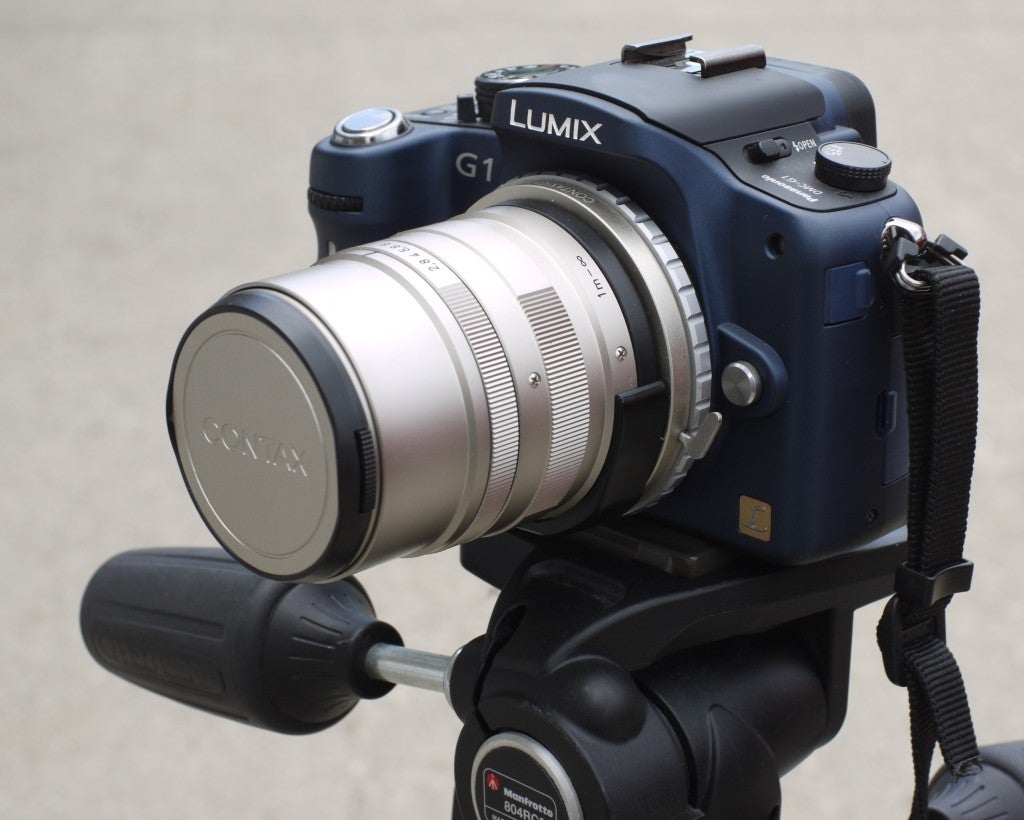
I already had 2 of these beautiful Carl Zeiss Contax G lenses, widely considered some of the finest lenses ever made, used on Contax's excellent G series rangefinder cameras in the 1990's (I just found an excellent page about the G series cameras and lenses here) . I have the 35 and 45mm Contax G lenses, and I'm also using the same adapter pictured here. The segmented ring right up against the camera body is the focus ring - it's actually part of the adapter itself and a huuuge improvement over the tiny little knurled wheel in the cheap adapters I originally bought that you have to turn by jamming your fingertip in between the bottom of the lens barrel and the tripod head. Now smooth focus pulls are possible with these excellent lenses. Edit - after discovering that page I linked to above about the Contax G cameras and lenses, I now know that it's only the 45mm that's considered in a class above all other DSLR lenses (of the 1990's anyway) and on a level instead with Leica rangefinder lenses, and apparently that's only in terms of sharpness. Bokeh is a little funky because they used a mere 6 blades for the iris - this can result in hexagonal shapes in the highlights of out-of-focus areas, as opposed to the circular highlights seen in rounder iris designs using 9 or more blades. Good to know! I learn more about the subtle intricacies of photography every day.

And yeah, now I know - a 35mm and 45mm lens are so similar there's really no reason to have them both in your kit - hey, when I bought these I was at the beginning of my learning curve concerning interchangeable prime lenses. Now I know better!

One problem associated with the small-format Micro Four Thirds system when using legacy lenses (old lenses made for either 16mm cine cameras or pre-digital stills cameras) is the difficulty of getting ahold of a decent wide angle lens that covers the sensor and doesn't vignette around the edges. Well, I did a bit of research and discovered there's a guy going by the web name ekoehler7 (not sure if he wants his real name spread around) who has solved this problem - he starts with a couple of excellent wide-angle C-mount lenses that already come very close to covering the sensor - a Fujinon-TV 12.5mm and a Fujinon-TV 25mm, and then he modifies them to open up the light pathway and widen the image circle considerably. Other people have done modifications, but not to the extent he does - he disassembles them and really goes to work, using a lathe and hand tooling and really does a number on them, almost entirely eliminating the vignetting and dark corners. There's a page about it on his site: Ekoe Camera (click to see the 12.5mm f1.4 Fujinon lens). Edit - looking at his site, I see he has now solved the problem entirely and can get full coverage with no vignetting! I've asked him to give my lens the full coverage treatment. Awesome news for m4/3 users looking for a good wide angle lens!!

He's doing one for me now. These Fujinons are some excellent little C-mount lenses in their own right - made for TV cameras, or probably actually for 16mm film cameras that were used to shoot TV material, which was quite common, and the cameras and lenses had to be top notch.

Olympus E-P2 + ekoehler7 modified Fujinon-TV 12.5 mm f1.4

Here's the Fujinon 12.5 on a Pentax E-P2, and in fact this very lens was modified by ekoehler7 himself. Click the image to read about the process on Gekopaca's Flickr stream. It was Gekopaca's pics and video that convinced me to go this route.

So - now I've got a 12.5 (soon anyway), a 25, a 35 and a 45... wow, talk about overkill!! I'll probably be selling one of them (can't bear to part with any of them actually!) along with most of the automatic Panasonic lenses I bought in the beginning. Collecting legacy lenses is big now since they make the M4/3 cameras the most adaptable system ever offered, and a lot of fun to boot! Plus anyone who has old C-mount or other types of lenses laying around can just get the right adapters and bring new life to the old lenses. So it's not hard to turn around and sell a lens if it works on a M4/3 camera.

The hiccup is almost past now - as soon as my Firewire adapter comes in I'm ready to lock myself in the studio again and spend these incredibly beautiful spring days laboring in darkness to bring forth life where there was none... though for now it's pretty nice to get some yard work done and enjoy the perfect weather.