
Sunday, July 08, 2012
Upcoming documentary about European puppetry arts
Byrne Power - Alaskan artist, filmmaker and puppetry enthusiast.
He has firsthand knowledge of the world of European puppet theater and puppetfilm (something I know about only from imported videos and from reading websites). Apparently he's been searching for a documentary that covers this fertile ground but has had no luck, and so he decided to make one himself. He seems to know the Quays and Svankmejer or at least to have connections with them and apparently they're willing to do interviews with him, assuming he manages to scrounge together the money he needs to get this thing off the ground.
Let's make it happen. Please donate what you can. We need this film to be made!
Here's a link to his campaign site: Gravity From Above


Tuesday, June 19, 2012
Kubrick on the problem of rationalism

"There's a side to the human personality that somehow senses that wherever the cosmic truth may lie, it doesn't lie in A, B, C, D. It lies somewhere in the mysterious, unknowable aspects of human thought and life experience. Man has always responded to it. Religion, mythology, allegories - it's always been one of the most responsive chords in man. With rationalism, modern man has tried to eliminate it, and successfully dealt some pretty jarring blows to religion. In a sense what's happening now with films and popular music is a reaction to the stifling limitations of rationalism."
- Stanley Kubrick interviewed by William Kloman, New York Times
Tuesday, April 24, 2012
That Pro-tog thing that I do

Lol ok, I've stopped arguing with Shelley when she calls me a pro photographer, even though it's far from the truth - I know she's just expressing admiration and enthusiasm, and I appreciate that. I do manage to get a decent shot now and then, but mostly by sheer dumb luck. Trust me, you don't want to see how many pictures I had to take before I got the one above, and I'm not totally happy with it, but I'm getting better.
Since getting the G1, and especially since getting legacy lenses for it, I've been looking into photography technique more and more, and one of the best resources I've stumbled across is Ken Rockwell's site. What he does is pretty much the opposite of the type of controlled-lighting fully manual studio photography we stopmotionistas do - he takes his camera out in the real world and uses fully automatic settings and has to rely on nature to provide him with lighting and decent conditions.
But.. I LOVE his strenuously repeated advice, which is basically that if you want to get good, stop fiddling around with technical crap and take a lot of pictures. The equipment you use is not important, what's important is COMPOSITION - and a few other elements that taken together add up to visual art.
I've read a lot of his articles now, and he talked me into buying the Kindle version of a book called The Art of Photography by Bruce Barnbaum, which he hails as the best book ever written on the subject. And I'm so glad I did! Being a lifelong student of art, having learned most of what I know by drawing in pencil and then learning to paint and sculpt a bit, I've long had some familiarity with the basic principles of visual art, but my ideas on photography were a bit vague until reading this book. Now they're firming up nicely.
Anyone who shoots movies should pay attention to cinematography, which is essentially photography in motion with storytelling. I'll never be half the photographer Kubrick already was in his teens when he was shooting award-winning covers for Life magazine, but dammit I'm gonna push as hard as I'm able toward it!!
If you click on the picture above you can see a few more I shot in my yard this morning at Flickr. Rockwell got me all fired up about shooting "in the field" - and even though it uses very different techniques than stopmo, it's a form of cross-training - that and it's just a lot of fun!! I want to do a lot more, keep exercising my photographic eye and developing my sense of composition. And also - it's nice to get out into the real world now and then!!
Friday, March 30, 2012
Legacy lenses
I took a break from animating to put together this little video showing my legacy lenses - well, the ones that are currently in my possession anyway. Sorry if I got a little carried away with putting on and taking off every accessory on every lens, including the lens caps! The video slideshow is the fun way to look at my collection, but YouTube has seriously blurred things to the point where you can't make out details at all (unless you click through and switch to 1080p resolution on YouTube) - so I've also uploaded a few pics to Flickr where you can see each lens in far more detail than you'd probably ever care to:
Wollensak Cine Raptar 1" (25 mm) f2.5 Click the images to see them on Flickr
Above and below are my 2 C-mount Cine lenses, made for 16 mm movie cameras. These could date as far back as somewhere in the 30's, and I suspect the little one above just might. I got it from eBay for a song, with an old Revere movie camera attached! The camera doesn't work, I'm using it strictly as a rear lens cap. In the video above you can see, this little sucker breaks down ridiculously far - there's a lens hood that comes off and then there's another piece that also comes off - not sure what that piece would be called. This one looks really crazy on my camera. Unfortunately it also vignettes pretty badly - so bad the photos are inside of black circles. It also doesn't have a focus ring. Not sure this one is worth using - glad I got it for $25!
Wollensak Cine Raptar 2" (50 mm) f2.5
This one is much more like it! Another C-mount lens made for 16 mm movie camera use, but this one doesn't vignette at all (a lot of the 25 mm and under ones do on m43 cameras). This is a hefty and beautifully worked hunk of steel. Has a very cinematic look because of the way it renders highlights in out-of-focus areas. In fact all the legacy lenses I've got ahold of are extremely cinematic. The front section is a hood that comes off.
Fujinon-TV 25 mm f1.4
This one is a CC TV lens, built for security camera, machine vision or closed-circuit TV use. Vignettes just ever-so-slightly right in the very corners in 16:9 mode, but when I crop to widescreen format that should disappear entirely. It actually looks rather pleasant, and generally can't be seen at all in dark shots (which I've been known to use now and then.. ), but if necessary I can crop it further and still end up with greater than HD resolution. This is the companion lens to my even wider 12.5 mm f1.4, which is currently in England being modified to eliminate the vignetting entirely (as detailed in my last post). These two have the lowest f-stop number at 1.4, meaning the aperture (iris) opens up nice and wide to let in lots of light - what's known as a fast lens. The faster a lens is, the shallower depth of field you can capture with it.
Carl Zeiss Contax-G 45 mm f2
And finally my two Contax-G lenses above and below. I described them well enough in the last post I don't feel the need to do it again. But I did feel bad for posting a web pic of somebody else's lens in that post, so thought I'd like to post pics of my own.
Carl Zeiss Contax-G 35 mm f2
Carl Zeiss Contax-G 45 mm f2
And finally my two Contax-G lenses above and below. I described them well enough in the last post I don't feel the need to do it again. But I did feel bad for posting a web pic of somebody else's lens in that post, so thought I'd like to post pics of my own.
Carl Zeiss Contax-G 35 mm f2
Ok, enough.. time to get back to the actual animatin'!!
Thursday, March 22, 2012
Hiccup

Well this sucks - I was on a roll, doing shots in Cosmo's every day, and suddenly my computer died. Luckily I had backed up most of my important files, including the shots I had done, but I've had to order a new iMac and get the right software back on it, and now I'm waiting on an adapter to make my Firewire 400 cord fit into the Firewire 800 socket on the new computer so I can plug my camera in (via my trusty old Canopus ADVC-100 analog/digital converter) and get back to work.
Actually a few other things happened that have somewhat changed my approach to this film too. For one, I discovered that I was getting some pretty horrendous flicker. I had done a couple of flicker tests with the G1 and it seemed steady as a rock, but now suddenly it's flickersville! I thought I might have just messed something up in a menu somewhere, and after a while I found that I had actually jogged a switch on top and switched it to auto exposure, but when I switched it back to manual (and made sure I was also on full manual in the menus) I found I was still getting flicker. And then it occurred to me - when I did the flicker tests, I just shot a bunch of pics without moving anything in between shots - but while animating I'm putting my hands in front of it and then withdrawing them in between each frame, and the camera must be re-adjusting the exposure for my pale hands, and then re-adjusting after I pull them out, and it isn't hitting the exact same mark every time. I can only assume this is what's going on, though it's still possible I messed something up in the complex menus and haven't been able to figure out how to fix it.
Well, whatever - I decided to fix it the sure way, by using only manual legacy lenses for animation. If the camera's little pea brain can't communicate with the lens, it can't go messing with my exposure settings!
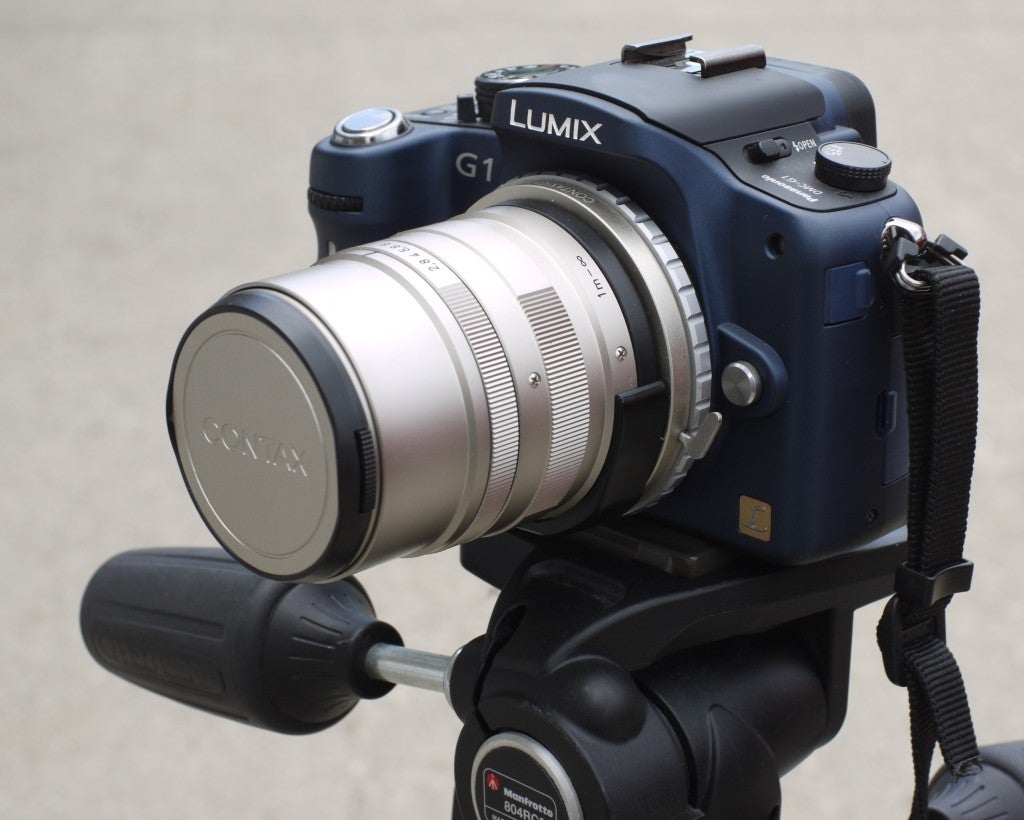
I already had 2 of these beautiful Carl Zeiss Contax G lenses, widely considered some of the finest lenses ever made, used on Contax's excellent G series rangefinder cameras in the 1990's (I just found an excellent page about the G series cameras and lenses here) . I have the 35 and 45mm Contax G lenses, and I'm also using the same adapter pictured here. The segmented ring right up against the camera body is the focus ring - it's actually part of the adapter itself and a huuuge improvement over the tiny little knurled wheel in the cheap adapters I originally bought that you have to turn by jamming your fingertip in between the bottom of the lens barrel and the tripod head. Now smooth focus pulls are possible with these excellent lenses. Edit - after discovering that page I linked to above about the Contax G cameras and lenses, I now know that it's only the 45mm that's considered in a class above all other DSLR lenses (of the 1990's anyway) and on a level instead with Leica rangefinder lenses, and apparently that's only in terms of sharpness. Bokeh is a little funky because they used a mere 6 blades for the iris - this can result in hexagonal shapes in the highlights of out-of-focus areas, as opposed to the circular highlights seen in rounder iris designs using 9 or more blades. Good to know! I learn more about the subtle intricacies of photography every day.
And yeah, now I know - a 35mm and 45mm lens are so similar there's really no reason to have them both in your kit - hey, when I bought these I was at the beginning of my learning curve concerning interchangeable prime lenses. Now I know better!
One problem associated with the small-format Micro Four Thirds system when using legacy lenses (old lenses made for either 16mm cine cameras or pre-digital stills cameras) is the difficulty of getting ahold of a decent wide angle lens that covers the sensor and doesn't vignette around the edges. Well, I did a bit of research and discovered there's a guy going by the web name ekoehler7 (not sure if he wants his real name spread around) who has solved this problem - he starts with a couple of excellent wide-angle C-mount lenses that already come very close to covering the sensor - a Fujinon-TV 12.5mm and a Fujinon-TV 25mm, and then he modifies them to open up the light pathway and widen the image circle considerably. Other people have done modifications, but not to the extent he does - he disassembles them and really goes to work, using a lathe and hand tooling and really does a number on them, almost entirely eliminating the vignetting and dark corners. There's a page about it on his site: Ekoe Camera (click to see the 12.5mm f1.4 Fujinon lens). Edit - looking at his site, I see he has now solved the problem entirely and can get full coverage with no vignetting! I've asked him to give my lens the full coverage treatment. Awesome news for m4/3 users looking for a good wide angle lens!!
He's doing one for me now. These Fujinons are some excellent little C-mount lenses in their own right - made for TV cameras, or probably actually for 16mm film cameras that were used to shoot TV material, which was quite common, and the cameras and lenses had to be top notch.

Here's the Fujinon 12.5 on a Pentax E-P2, and in fact this very lens was modified by ekoehler7 himself. Click the image to read about the process on Gekopaca's Flickr stream. It was Gekopaca's pics and video that convinced me to go this route.
So - now I've got a 12.5 (soon anyway), a 25, a 35 and a 45... wow, talk about overkill!! I'll probably be selling one of them (can't bear to part with any of them actually!) along with most of the automatic Panasonic lenses I bought in the beginning. Collecting legacy lenses is big now since they make the M4/3 cameras the most adaptable system ever offered, and a lot of fun to boot! Plus anyone who has old C-mount or other types of lenses laying around can just get the right adapters and bring new life to the old lenses. So it's not hard to turn around and sell a lens if it works on a M4/3 camera.
The hiccup is almost past now - as soon as my Firewire adapter comes in I'm ready to lock myself in the studio again and spend these incredibly beautiful spring days laboring in darkness to bring forth life where there was none... though for now it's pretty nice to get some yard work done and enjoy the perfect weather.
Tuesday, February 21, 2012
At long last life
Life begins to stir in Cosmo's Tavern. I'm just messing around a bit getting ready to start actual animation on this thing.
Tuesday, July 05, 2011
TV that's better than movies
Breaking Bad s3 e12 opening
The new season of Breaking bad is about to break, and AMC has been showing all the previous seasons to get everyone hyped up for it. Man, what a fantastic show!! The incredible music video style montage above is just one example.
Below are a few screenshots showing a taste of the innovative cinematography. I've rarely seen interiors shot so dark, with just pools of light and layering used to separate elements.
Below are a few screenshots showing a taste of the innovative cinematography. I've rarely seen interiors shot so dark, with just pools of light and layering used to separate elements.

In the shot below, bear in mind that green (the color of money) in this show represents a dream of a better life - generally through money obtained via illegal and self-destructive means. Wendy's vertical blinds are a brilliant representation of jail bars too. I also noticed in the montage above that her headboard resembles the Breaking Bad title screen.

Here's a series of over-the-shoulder shots that I find amazing...


... Ending with Walt looking tiny and helpless behind his baby's crib in one of those empty dark rooms. Brilliant I tell ya!
And a sequence shot in a large room using two windows covered by opaque yellow shades. The glowing yellow rectangles are used perfectly here as framing devices and abstract shapes to create beautiful compositions.


At home with the Whites - a tranquil domestic dinnertime scene.


... You know what this kind of lighting really is? It's Chiaroscuro - figures emerging from darkness into light. Like the stuff Caravaggio used to paint. Look it up if you don't believe me!
I've been hard at work on my film... and I don't want to show too much just before it gets released, so I'm not posting about it. Soon though, you'll be able to watch it. I'm not doing the festival thing, so as soon as I get it done I'm posting it here for the world to see.
Subscribe to:
Posts (Atom)